


Title tags are one of those SEO details that feel small. But they quietly decide how your pages show up in search. They also shape whether people click you or scroll past. In this guide, you’ll learn how to write title tags for SEO that match intent, read naturally, and still include the terms you need. We’ll cover practical length rules, click-focused writing, and a few formulas you can reuse. And we’ll get specific about what to avoid, since most title tag problems come from repeatable mistakes. If you’re updating a site with lots of pages, this will save you time and headaches.
Best for: Site owners and SEO practitioners who want titles that rank, earn clicks, and stay consistent across many pages.
Not ideal when: Your page has unclear intent, thin content, or mismatched headings that a title tag can’t realistically “fix.”
Good first step if: You can name your page’s primary query, pick one modifier, and state a clear outcome.
Call a pro if: Your site has widespread duplicate titles, indexing issues, or pages competing with each other for the same query.
Quick Summary
- Your title tag should mirror the searcher’s goal, not just repeat keywords.
- Keep the core promise early, since truncation and scanning are real.
- Use one primary keyword and one helpful modifier, not a list.
- Match the title to the page’s H1 and on-page content to reduce pogo-sticking.
- Avoid templates that produce duplicates across categories, tags, and pagination.
- Update titles in WordPress carefully, then re-check snippets after recrawls.
What is a Title Tag
A title tag is the page title Google and users often see as the blue link in search results. It lives in the HTML head and labels what the page is about. In WordPress, it’s usually controlled by your SEO plugin, theme settings, or the post title, but it is not the same as your on-page H1.

Your title tag is both a ranking and click signal that must match the page’s real value. If it overpromises, users bounce. If it’s vague, users skip it.
Example: a running-shoe guide might use “Best Running Shoes for Flat Feet (What to Look For)” as the title tag, while the H1 can be longer or more brand-toned.
Title tags are the headline. Meta descriptions are the supporting pitch. For descriptions, see adding meta descriptions.
Why Title Tags Matter for SEO
Title tags matter because they help search engines and searchers understand your page fast. They influence rankings by reinforcing topical relevance. They also influence clicks by setting expectations and standing out in crowded results.
You’ll see this most clearly on “boring” queries. Lots of pages match the keyword. The title that feels most helpful wins the click. That click behavior can feed back into performance over time. So what does this mean in practice? You write for clarity first, then you optimize.
For example, someone searching “invoice template for contractors” likely wants a downloadable format. A title like “Contractor Invoice Template (Simple, Editable Format)” sets a clear outcome. A title like “Invoice Template” doesn’t.
How Long Should a Title Tag Be
A good title tag is short enough to avoid awkward truncation, but long enough to make a specific promise. Don’t chase an exact character count. Aim for a front-loaded message that still reads well if cut off.
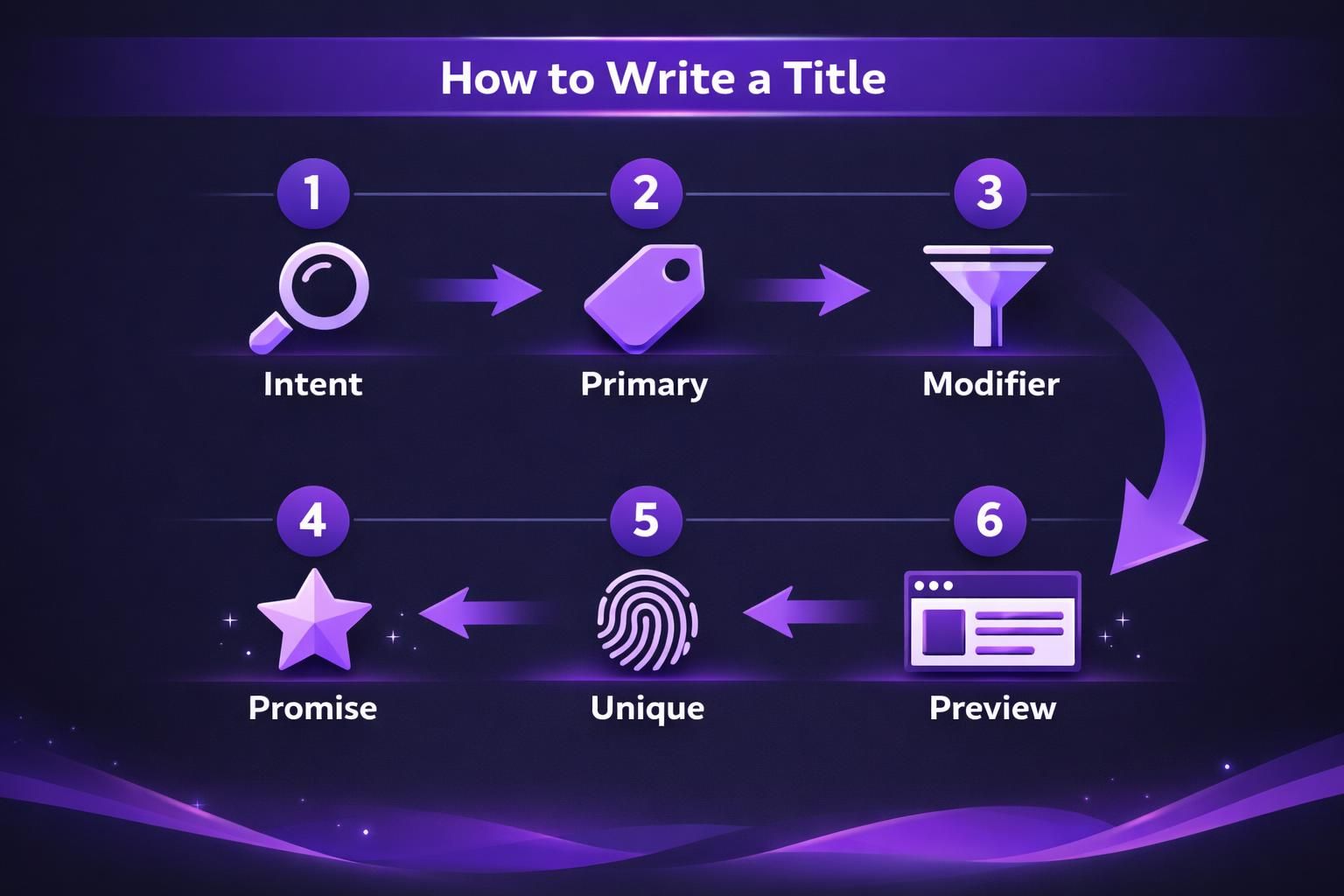
Put the main topic and key modifier near the start. Leave the brand for the end if you include it, and avoid extra qualifiers that don’t change intent. For example, “How to Write a Title Tag That Gets Clicks (Checklist)” can truncate gracefully. A bloated version like “How to Write a Title Tag That Gets Clicks for SEO and Rankings in Google Search Results” wastes space.
Quick habits:
- Lead with the primary query or close variant.
- Add one intent-matching modifier like “checklist” or “examples.”
- Push brand names to the end or skip them on informational pages.
- Remove filler words that add no meaning.
How to Write a Title Tag That Gets Clicks
A click-worthy title tag makes a specific promise and proves relevance fast. Match the query’s intent, use plain language, and add one differentiator. You’re not writing an ad. You’re writing the clearest label in the list.
Start by naming the page’s job: how-to, comparison, template, pricing, or troubleshooting. Then add one detail that reduces uncertainty, such as scope, a constraint, or a clear outcome. For example, “Local SEO Checklist for Service Businesses (On-Page + GBP)” is more specific than “Local SEO Checklist.”
Use this simple build:
- Primary topic phrase that matches the query.
- One modifier that signals value or format.
- Optional: “steps,” “examples,” or “common mistakes.”
- Optional: brand name at the end.
Keep alignment with the page. If you promise templates, include them early. If you promise rules or pitfalls, deliver a dedicated section. For broader refreshes, pair title work with content updates via updating old posts.
Title Tag Formulas That Work
Reliable title tag formulas work because they mirror how people pick results. They surface the topic, intent, and payoff fast. You can reuse these patterns across a site without making every title feel copied.
1) How-to with outcome Example: “How to Write Title Tags for SEO (Rules + Examples).”
2) Benefit plus constraint Example: “Email Subject Lines That Get Opened (Without Sounding Spammy).”
3) Best-of with audience Example: “Best Budget Laptops for Students (What to Prioritize).”
4) Problem, then fix Example: “Why Your Pages Aren’t Indexing (Common Causes and Fixes).”
5) Comparison with decision cue Example: “Ahrefs vs Semrush (Which Fits Content Teams).”
To avoid near-duplicates, vary the modifier. Use “checklist” on one page, “examples” on another, and “mistakes” on a third. Also match the formula to the SERP. If results are all “best-of” lists, a “how-to” angle may underperform.
If you standardize titles, keep internal linking clean too, including WordPress internal link basics.
What Not to Do With Title Tags
The fastest way to ruin a title tag is to chase keywords instead of clarity. Over-optimization makes titles look untrustworthy. It also increases duplicates, which is a quiet killer on large sites.
Avoid these common mistakes:
- Keyword stuffing with multiple near-identical phrases
- Titles that don’t match the page’s real content
- Boilerplate titles copied across pages
- Using only a brand name or only a vague category
- Excessive punctuation or clickbait language
- Putting the important words at the end
For example, “How to write a title tag, how to write title tags, title tag best practices SEO” reads like a tag cloud. It won’t earn clicks. It can also look low-quality.
And watch for cannibalization. If you have “Title Tag Best Practices” and “Title Tag Rules,” they may fight each other. For example, two posts both targeting “title tag best practices seo” can split signals. In that case, merge, redirect, or differentiate intent. If you’re doing sitewide cleanup, a broader technical SEO audit checklist can reveal patterns behind title issues.
How to Update Title Tags in WordPress
In WordPress, you usually update title tags in your SEO plugin’s title field, not by changing the post title alone. The post title can stay as the H1, while the SEO title is tuned for SERPs. This helps when your editorial title is long, clever, or brand-heavy.
Example: your post title might be “The Tiny SEO Details That Add Up.” Your SEO title could be “On-Page SEO Checklist (Small Fixes That Matter).” The page keeps its voice while the snippet stays clear.
A clean process:
- Choose the URL and confirm the main query.
- Rewrite the SEO title to match intent and add one modifier.
- Check for duplicates across the site.
- Verify it matches the page headings and intro.
- Save, then monitor performance over time.
Conclusion
Writing better title tags is mostly about being specific and honest. Put the main topic first. Add one modifier that matches intent. Keep it readable if it truncates. And avoid templates that create duplicates across your site. If you’re wondering how to write title tags for seo at scale, start with your top pages. Rewrite titles that underperform, then expand the same patterns to similar content. Your next step is simple. Pick one page, draft three title options, and choose the clearest one.