
If you’re updating content this year, you need an on-page seo checklist 2025 that reflects how Google actually evaluates pages now. Rankings still hinge on relevance. But they also hinge on clarity, usability, and whether your page makes the searcher’s job easy. The good news is that on-page work is still the highest-leverage SEO you can do per page. And it’s mostly under your control in WordPress.
In this guide, you’ll get a practical, page-by-page checklist. You’ll also learn how to avoid common traps like intent mismatch, thin content, and accidental duplicates. And yes, we’ll cover CTR elements, heading hierarchy, schema markup, and the small technical checks that prevent big indexing headaches.
Best for: WordPress site owners updating existing pages that rank but underperform on clicks, engagement, or conversions.
Not ideal when: You have crawling or indexing problems across the whole site that block pages from appearing at all.
Good first step if: You’re refreshing one priority page and want a repeatable on-page SEO audit workflow for future updates.
Call a pro if: You see widespread deindexing, canonical chaos, or faceted duplicates that you can’t confidently diagnose.
Quick Summary
- Start with one primary keyword per page, then map supporting topics to cover the full intent.
- Write a title tag for relevance and clicks, not just keyword placement.
- Use a clean heading hierarchy so both readers and crawlers can skim and understand structure.
- Improve content depth by answering follow-up questions and adding firsthand experience signals.
- Check indexability basics like canonical tag, robots meta tag, and internal links to the page.
What “On-Page SEO” Includes in 2025 (and What it Doesn’t)
On-page SEO in 2025 means making each page the clearest answer to one intent. It includes content optimization, keyword mapping, titles and meta descriptions, and page-level technical hygiene like canonicals and basic indexability checks, often handled in WordPress via the editor and SEO plugin. It does not fix server issues, broken templates, or sitewide crawl problems, and it can’t replace authority building. It also won’t save a page targeting the wrong query. Example: targeting “best running shoes” while selling one model is an intent mismatch. Validate the page’s job before tweaking copy.
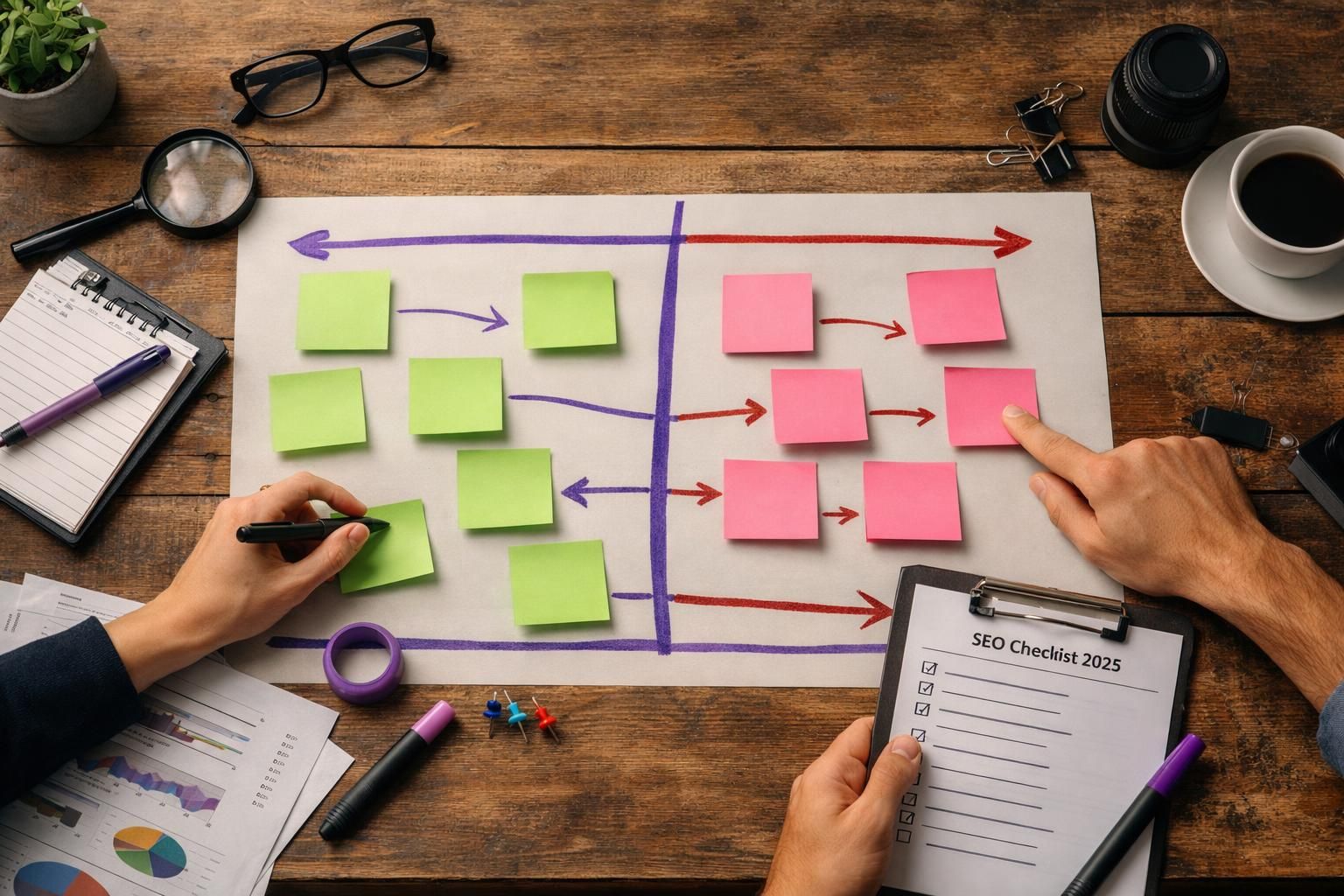
On-page Vs. Technical Vs. Off-page (Quick Definitions)
On-page SEO is everything you change on the page to improve relevance and usability. Think headings, copy, internal links, images, and schema markup. Technical SEO is site infrastructure and crawl systems. Think XML sitemap handling, redirects, and performance tuning. Off-page SEO is what the web says about you. Think backlinks, citations, and brand signals.
For instance, a broken canonical tag is often a technical issue. But setting the correct canonical on one page is on-page hygiene. And if your page needs authority, no amount of rewriting will replace off-page work.
If you want a clean workflow in WordPress, keep your tasks separated. Do on-page first for priority pages. Then escalate technical items that repeat across templates.
Keyword & Intent Setup Before You Optimize
Lock keyword research and intent before editing. Each page should target one primary keyword and a tight cluster of related terms that serve the same intent, so you avoid cannibalization and thin content. Start in Google Search Console: find queries with impressions but low clicks, then compare them to the page’s promise. If the mismatch is large, reposition the content instead of polishing wording. Example: a “WordPress image SEO” post ranking for “alt text examples” suggests template intent; add that section or create a new page and interlink. Pull queries after you’ve connected Search Console and filter by URL.
Map the Primary Keyword + Supporting Topics (NLP/semantic Terms)
Semantic terms show topical coverage without repeating one phrase. Build a short map of subtopics, entities, and related queries that the SERP expects. Ensure the primary keyword appears in the H1, intro, and a fitting subheading. Use related keywords naturally in context, not in a forced block. Include key entities where they belong, such as canonical tag, URL slug, and schema markup. Cover definitions, steps, and troubleshooting. Example: for “on-page SEO audit checklist,” searchers expect a step-by-step list with practical checks like robots meta tag and internal links, not just writing advice.
Confirm Search Intent and the “Right” Page Type
Search intent alignment means your format matches what Google is already rewarding for the query. In most SERPs, you can spot patterns fast. Are top results checklists, tutorials, tools, or category pages? That pattern is a hint about the “right” page type.
Do these checks before editing:
- Identify the dominant intent: informational, commercial, navigational, or local.
- Match content format: checklist, guide, template, or comparison.
- Match content angle: “2025,” “for WordPress,” “for beginners,” or “advanced.”
- Confirm you can meet the implied promise in the title.
For instance, if the SERP is full of short checklists, a 5,000-word essay may underperform. But if the SERP has deep guides, a thin page won’t survive. And if your page is a product pitch, but the intent is informational, you’ll see high pogo-sticking.
SERP-Facing Elements (Improve CTR)
SERP-facing elements determine whether a ranking earns clicks. Prioritize the title tag, then use the meta description as preview copy that matches intent and sets expectations. Overpromising hurts engagement. Draft two title/description options, choose the one that fits the query, and keep language concrete. Remember social previews: Open Graph fields often reuse these values when a page is shared. A clearer title can increase traffic more than small on-page edits. For a repeatable workflow, generate drafts, then refine them yourself using meta title drafts.

Title Tag Checklist
A good title tag is specific, readable, and aligned with what the page actually delivers. It should include the primary keyword or a close variant. But it should also answer, “Why click this one?”
Run through these checks:
- Put the primary keyword near the front when it reads naturally.
- Add a clear qualifier like “2025,” “for WordPress,” or “checklist.”
- Avoid duplicate titles across posts and pages.
- Remove filler words that don’t add meaning.
- Keep it human. Don’t stack related keywords.
For example, “On-Page SEO Checklist 2025 for WordPress Pages” is clearer than “On-Page SEO, On Page SEO, On-Page Optimization Checklist.” The second one reads spammy. It also signals low quality before the click.
Meta Description Checklist
Meta descriptions don’t force rankings, but they can increase CTR by setting accurate expectations. Write it like a two-sentence value pitch that matches the page. Checklist: summarize the outcome, add one specific detail (for example, “title tags, headings, canonicals”), include a light CTA, don’t repeat the title verbatim, and front-load the key point for mobile. If the post is step-by-step, say so. If it’s WordPress-focused, mention WordPress. That pre-qualifies clicks and reduces bounces from readers expecting general SEO theory instead of an actionable checklist.
Page Structure & Content Quality Checklist
Structure drives skimmability, UX, and ultimately performance. Prioritize readability, clean heading hierarchy, and sufficient depth before micro-optimizing keyword placement. Do a 20-second scan without reading: do headings, bullets, and CTAs make the flow obvious? If not, restructure first. Example: a long WordPress tutorial without clear H2 sections forces scrolling, hides critical steps, and increases bounces to clearer competitors. When updating many posts, start with a fast triage so you stay consistent. Use bulk content tools to queue pages before opening each editor.
H1/H2/H3 Hierarchy and Scannability
Your heading hierarchy should match the way someone thinks through the task. Use one H1 tag per page. Then use H2 tag sections for major steps. Use H3 tag subsections for details and edge cases.
A practical checklist:
- One clear H1 that matches intent and page topic.
- H2 sections that reflect the main checklist categories.
- H3 sections that break down steps, not random thoughts.
- Short paragraphs and occasional bullets for scan paths.
- Descriptive headings that don’t rely on jokes or vague wording.
For instance, “URL, canonical tags, and indexability checks” tells the reader exactly what they’ll get. “The boring stuff” doesn’t. It also fails accessibility expectations for navigation and screen readers.
Content Depth, E-E-A-T Signals, and Freshness
Depth in 2025 means answering the main question plus key follow-ups, with signals that the author has real experience. Add practical steps, constraints, and examples, and refresh content when tools, interfaces, or SERPs change. Improve trust with specific instructions, firsthand notes, and decision cues, plus helpful screenshots when needed. Make ownership clear with visible authorship and editing responsibility. Example: if you recommend schema, say which type fits and why; if you mention Core Web Vitals, name common offenders; if the WordPress UI changed, update steps so readers can follow them today.
On-Page Technical Essentials
These page-level checks prevent crawl, duplication, and indexing errors that quietly cap rankings. In an on-page seo audit checklist, start with URL structure, canonical tag, and indexability signals (robots meta, noindex, redirects). Then review structured data, mobile friendliness, and speed. Many fixes are safe in WordPress, but confirm what your plugin changes on live pages. A common failure: a canonical accidentally set to the homepage, causing a ranking drop. Validate crawl signals alongside supporting systems, especially your XML sitemap. Review it via sitemap configuration steps so sitemap coverage matches your indexation goals.
URL, Canonical Tags, and Indexability Checks
A clean URL slug and correct canonical tag prevent duplicate content and indexing confusion. Keep URLs short and descriptive. Avoid dates unless they matter. And don’t change a slug casually without a redirect plan.
Run this checklist on each page:
- URL slug uses simple words and matches the page topic.
- Canonical tag points to the preferred version of the page.
- Robots meta tag isn’t set to noindex by mistake.
- Only one indexable version exists, like non-www vs www.
- The page is internally linked from at least one relevant hub.
For example, a WordPress page can have tracking parameters. If those versions get indexed, you create duplicates. A correct canonical helps consolidate signals. If you see conflicting canonicals across paginated content or archives, that’s a red flag worth escalating.
Schema Markup to Earn Rich Results
Schema helps search engines classify your page and can unlock rich results, but it must match visible content. Never add FAQ schema without real Q&A, and don’t label a blog post as a product. Common types include Article/BlogPosting, FAQPage, HowTo, and BreadcrumbList. Choose based on what the page truly is. A checklist can fit HowTo only when it’s clearly procedural; if it’s mainly reference, Article is safer. If you want faster implementation, draft markup and validate it before publishing. You can follow schema generation workflow and then verify it mirrors the on-page sections.
Internal Links, Media, and Engagement Signals
Internal links, media, and engagement signals are where “good enough” pages become easy to navigate and trust. Internal links clarify topical relationships. They also improve crawlability and distribute authority. Media optimization improves comprehension, accessibility, and sometimes image search visibility. And engagement signals often improve when the page is simply easier to use.
Start with internal links. Add a few contextual links to supporting pages. Use descriptive anchor text. And fix broken links quickly. Then move to images and other media. Check image filenames, image compression, and image alt text. Add captions when they genuinely clarify the image.
Now look at engagement. Improve readability with shorter paragraphs and clearer headings. Add a table of contents if the page is long. Make CTAs match the reader’s stage, like “download template” versus “contact sales.” And keep mobile-first indexing in mind. Buttons should be tappable. Fonts should be readable. Layout shifts should be minimal, which also helps Core Web Vitals.
A quick checklist to finish:
- Add 3 to 8 internal links to relevant pages, spaced naturally.
- Use varied anchor text that describes the destination.
- Add one strong “next step” CTA that fits the intent.
- Compress and resize images so they don’t bloat page speed.
- Write image alt text for meaning, and leave decorative images blank.
- Include one or two external links when they genuinely help context.
For instance, a content audit checklist page might link externally to Google’s own documentation on structured data. That gives readers a source of truth. Just don’t turn your page into a link farm. A few high-quality external links are enough.
Conclusion
Your best results come from treating on-page work like a repeatable system, not a one-time rewrite. Start with keyword mapping and search intent. Then tighten SERP-facing elements for CTR. Then improve structure, depth, and E-E-A-T signals. Finally, finish with technical hygiene, internal links, and media optimization.
If you keep one habit in 2025, make it this: run the same on-page seo checklist 2025 every time you publish or refresh a WordPress page. You’ll catch duplicates early, prevent indexability mistakes, and keep content aligned with what searchers actually want.